


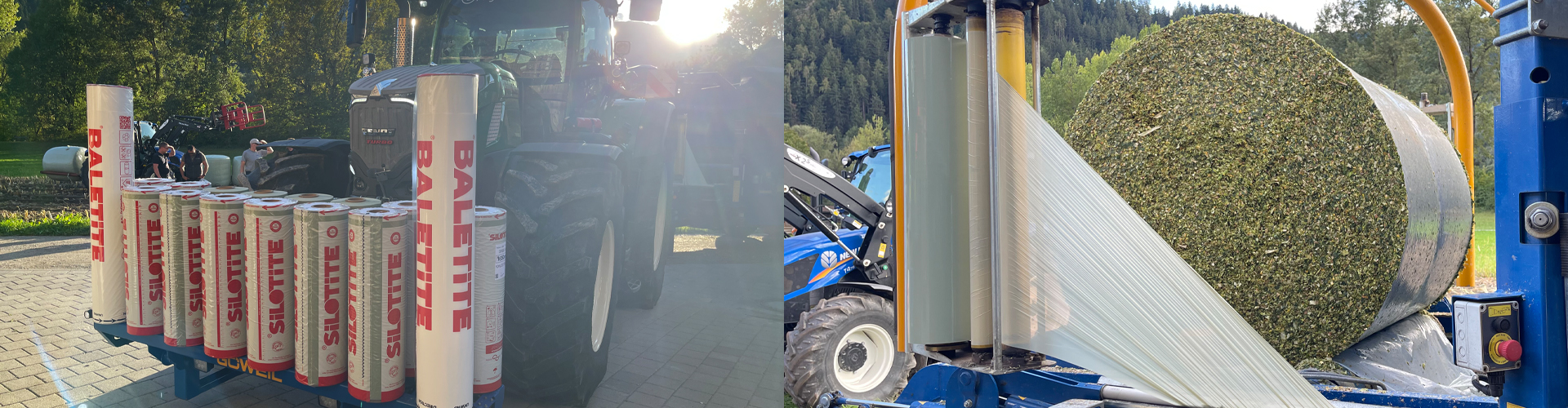
With this season’s maize harvest in progress, maintaining the density created in the compaction chamber is critical to protecting bales through storage, handling and feed-out.
A maize bale asks more of its film than simply keeping the weather out, unlike a conventional grass bale, chopped maize relies on the compaction process to create a dense, stable bale.
Once the bale leaves the machine, the mantle film has to hold that mass firmly together before the outer wrapping film provides the airtight barrier needed for fermentation and storage.
Johannes Frauscher of Silotite says this is why the combination of Baletite mantle film and Silotite Pro wrapping film has become his preferred system for maize.
Mr Frauscher says: “With maize, you have a lot of chopped material compressed into a small space. The machine gives you the density, but once that bale comes out, you need to maintain it,” he says.
“You don’t have the structure of long grass helping to hold everything together, so the mantle film is doing an important job.”
“For me, Baletite has a real advantage here because it's a stiffer. It gives excellent holding force around the bale and doesn’t need a high level of stretch to work effectively.”
That stiffness also matters during operation, particularly where baling conditions change through the season.
“With a film that stretches a lot, the machine can need more adjustment as temperatures change.
“Baletite works at a consistent stretch level, so the system performs more reliably across different baling conditions.”
Mr Frauscher says trials he has carried out comparing mantle films showed that the stiffer Baletite film helped the bale retain a tighter circumference.
“That means the bale stays more compact, and for fermentation you want as little oxygen in there as possible. When you are making a high-value maize bale, capturing every kilo of forage is vital.”
Silotite recommends using Baletite alongside Silotite Pro 1800 or Pro 2000 as the outer wrapping film. In most situations, Mr Frauscher recommends three to four layers of mantle film followed by six layers of wrapping film.
Where bales will be handled several times between baling and transporting, he advises increasing the outer wrap to eight layers.
“If the bale is made and moved once into storage, six layers will normally do the job. But if that bale is going to be loaded, transported, unloaded and handled several more times, I would recommend putting on two extra layers,” he says.
“The additional film cost is small compared with the value of the maize inside – the cost of spoilage far outweighs the initial investment.”
For six-layer systems, Silotite Pro 1800 is Mr Frauscher’s first recommendation, while Pro 2000 provides an established solution where eight layers and greater handling protection are required.
“Contractors need wrap they can trust without having to think about it every bale,” he adds. “With maize, you are dealing with dense, heavy bales and valuable feed. The film has to match that.”



