


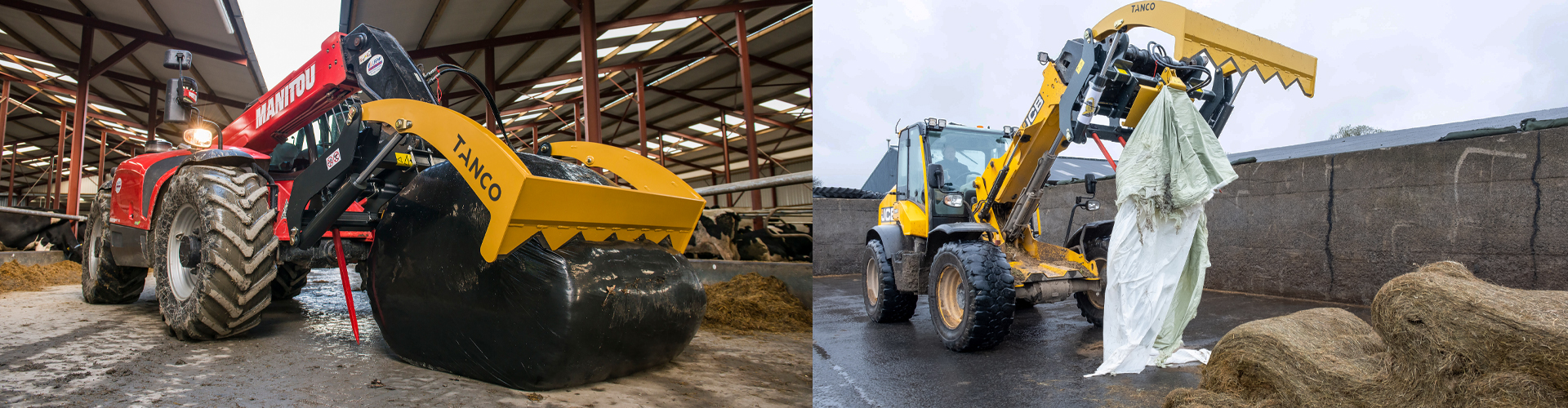
Handling and opening silage bales is an everyday task on the farm, but it can expose operators to serious risks. With the help of Silotite’s net replacement film (NRF), Tanco’s bale handling technology is helping farmers complete these tasks from the safety of the cab, while saving time at feed-out.
As seen in Farmers Guardian
Manually opening silage bales and climbing underneath them to remove wrap, is one of the riskiest jobs on farm, particularly when working alone with bales weighing up to a tonne.
Michael Dollard, UK and Ireland sales and support manager at Tanco, explains that reducing the number of times operators need to leave the cab when moving or feeding bales can significantly improve safety.
He says: “Farmers handle bales all the time, but it’s often when people are busy and rushing ahead to the next job that complacency creeps in, increasing the risk of serious injury.
“Once you’re out of the cab with livestock, slippery ground and machinery around you, the risk increases.”
That’s where Tanco’s BaleShear plays an important role.
A safer bale handling solution
Irish machinery manufacturer Tanco developed its i73 BaleShear after a farmer in Kilkenny asked for a safer and more efficient way to handle wrapped bales.
The machine cuts through the bale and clamps the wrapping, reducing the need for the operator to climb in and out of the tractor during feed-out.
“Traditionally, the farmer would need to get out of the loader once to cut the bale and again to separate the net from the film for recycling,” explains Michael.
“Tanco’s BaleShear cuts the bale and clamps the wrap for you, reducing the need to exit the cab.”
The machine’s safety technology has also been included within the farm safety category of Ireland’s Targeted Agricultural Modernisation Scheme, helping farmers invest in equipment designed to reduce manual handling.
See the Tanco i73 BaleShear in action here: Tanco I73 BaleShear
“The operator is safest in the seat of a tractor, not walking around machinery with a 600kg bale being held above them.”
The safety benefits of NRF
Traditional net wrap and outer stretch film often need to be cut and separated manually. This can turn feed-out into a two-person task, with one operator in the cab and another working on foot around the machinery.
“There’s always added risk if someone is walking around your machine, dipping in and out of view and disappearing behind the bale,” says Michael.
Switching from traditional net wrap to an NRF solution like Baletite, can help simplify the process.
The BaleShear can slice through the outer layer and the Baletite at the same time. Since both layers are film, the waste material can be collected together without needing to separate netting from film.
For a farmer feeding 500 bales each year, this approach could eliminate up to 1,000 climbs in and out of the tractor.
“When you put it like that, the reduced risk becomes hard to deny,” adds Michael.
Improving forage quality and reducing waste
Safer handling is not the only benefit of switching to NRF.
Lloyd Dawson, sales director at Silotite, says Baletite can also help preserve forage quality and prevent valuable silage from becoming caught in traditional netting.
“We’ve seen how switching from traditional net wrap to Baletite, can significantly reduce risk to operators, with the added benefit of increased forage quality,” says Lloyd.
“There’s also less waste as the forage doesn’t get caught in the netting. Home-grown forage is a precious commodity, and a kilo here and there from every bale soon adds up to a tremendous amount of waste across the season.”
Safer bale transport and stacking
NRF-bound bales tend to be more compact and uniform, making them easier to transport and stack securely.
Their consistent shape can help create a more stable stack, reducing the risk of bales moving or collapsing and causing injury or damage.
Farmers should always follow current Health and Safety Executive guidance when stacking round bales and ensure stacks are built on firm, level ground.
Small changes, significant safety gains
Farming remains one of the UK’s most hazardous industries, but practical changes to everyday working methods can make a meaningful difference.
Combining net replacement film with modern bale-handling technology can reduce manual handling, limit the time operators spend around moving machinery and make recycling easier.
At the same time, it can help protect forage quality, reduce waste and create more consistently shaped bales.
From baling in the field to feeding livestock during the winter, adopting a film-on-film system can support a safer, simpler and more efficient silage operation.



