


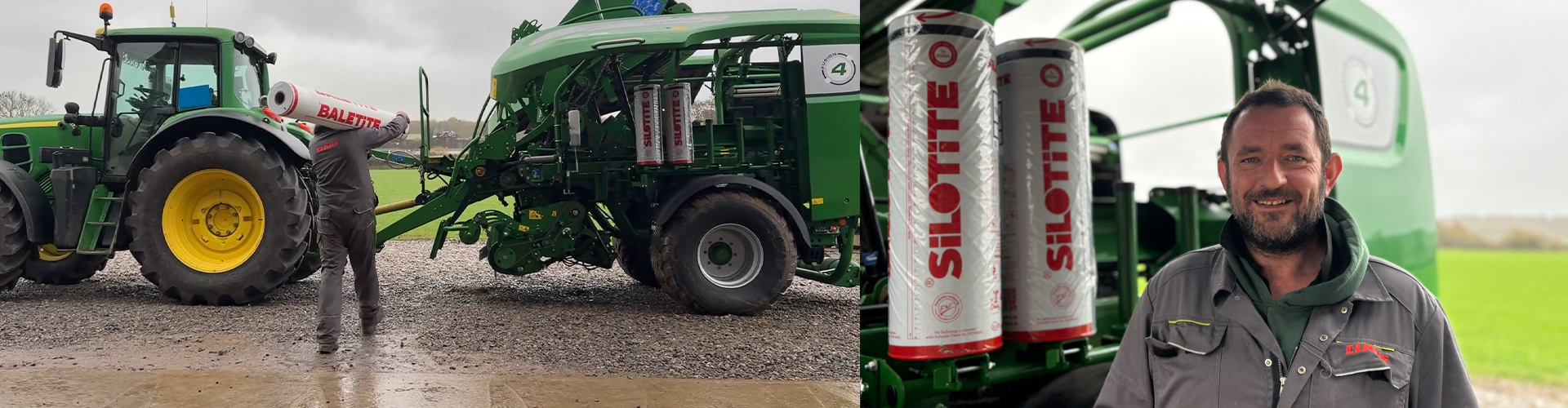
Andrew Snook, a farm contractor with over 26 years of experience in the agricultural sector, has seen his business evolve from a small operation to a full-service contracting business, offering square and round baling, mowing, wrapping, ploughing, drilling and hedge cutting.
Based in the Somerset, Andrew Snook’s contracting business has now been running for over two decades, working with dairy, beef, and arable farmers across a 25-mile radius.
With an increasing demand for more sustainable solutions in the industry, Andrew recently made the switch to using Baletite film-on-film technology, offering improvements in both operational efficiency and environmental impact.
The progression of the business
Starting out with just one tractor and a basic baler, Andrew’s business has grown significantly over the years.
“I began with a small mower and rakes, gradually expanding into baling in 2008 as the demand increased,” he explains.
“Over the years, we’ve added more machines – two square balers, a wrapper, and an even larger Claas baler.
The decision to scale up the business came with both challenges and rewards, including the need to adopt more advanced machinery and improve operational efficiency.
The introduction of new technology was crucial to managing the increased workload, which is why Andrew was open to innovations like film-on-film wrapping.
“We’ve been using net wrap for years, but I’m aware it’s difficult to recycle, and it had become an increasing issue for our customers," he explains.
Making the switch to Baletite
His exploration of alternatives led him to film-on-film technology, which offered both a higher-quality silage protection and a solution to the recycling concerns.
Andrew invested in a McHale Fusion 4 Plus, capable of applying net replacement film for his round-bale customers.
“The feedback from my customers has been overwhelmingly positive,” he states.
“We’ve now completed 5-6,000 bales with the new system, and the results have been fantastic; 90% of our customers now request film-on-film.”
“The film provides better coverage than net, reducing the risk of mould, and the quality of the silage is noticeably improved.”
"The added layers of film help to protect the silage better, ensuring that it retains its quality during storage,” he explains.
“When we first switched, there were some learning curves, especially getting the right tension on the film and ensuring the wrapper was calibrated properly. But after a few adjustments, it became second nature.”
Andrew is confident the switch was the right move: "The customer feedback has been great, and we don’t use nearly as much net wrap, it’s only used for hay and straw now,” he says.
Andrew concludes: “I’d rather produce fewer bales, but do it properly, using the best materials for the job.”



